Let’s Get One Thing Straight: I Love This Movie.
Before anyone reaches for the pitchforks, understand that I am about to spend an entire blog picking at one of the greatest horror films ever made, and I need you to know I do it out of love. The kind of love that only ever complains about the things it can’t stop thinking about.
Dawn of the Dead (1978) is, to me, damn near flawless. Romero took a zombie picture and smuggled an entire satire of American consumerism inside it — the dead shambling back through a shopping mall because some rotted part of them still remembers this is where they used to go. Where we still go. Mistaking a mausoleum for a paradise. It’s funny and it’s grim and it’s smarter than it has any right to be, and it earned every inch of its reputation. I’d set it on a shelf with maybe five other horror films and call the whole shelf perfect.
Except it isn’t. And it isn’t for a reason that has nothing to do with Romero, nothing to do with the effects, nothing to do with the script.
One performance choice, in one scene, roughly twenty minutes in, quietly costs that film a character arc — and it has bothered the absolute hell out of me for years.
The Scene
Early in the film — before the mall, before any of it — the group sets the helicopter down at a little airfield to refuel. It’s supposed to be a breather. Grab fuel, catch a breath, get back in the air. But the dead are already there, the way the dead are always already there in these movies, and it goes wrong the way it always goes wrong.
And Flyboy — Stephen, the pilot, Fran’s boyfriend, the father of the child she’s carrying, the one person in that group she is bound to by something other than circumstance — gets taken to the ground by one of them. Tackled. Flat on his back in the dirt, wrestling a reanimated corpse that wants to eat him, its teeth inches from his face. It is genuinely, viscerally awful to watch.
Which is exactly when the scene falls apart. Because the camera cuts to Fran. The woman who loves him. Standing there.
And she does nothing.
No scream. No flinch. No lunge toward him, no scramble for a weapon, no grabbing the nearest man, no sound. Nothing. She watches the love of her life fight for his life underneath a monster, and her face does roughly what your face does when the elevator is a little slow to arrive.
The Hammer Was Right There
Here’s the detail that turned my nitpick into an obsession.
There is a hammer. Not somewhere. Not in the truck, not back at the chopper, not conveniently offscreen so we can all agree there was nothing to be done. It is right there, in frame, in the dirt, close enough that Stephen — pinned, one forearm jammed under a dead man’s jaw, his whole body one bad second from being opened up — spends the back half of that struggle fighting toward it. That is what his free hand is doing. He is reaching.
And Fran is standing over the entire thing.
Two steps. That’s the whole ask. Two steps, bend, swing, and the scene is over and her partner is alive because of her. The blocking hands it to her. The camera hands it to her. The film is quite literally lying a solution in the dirt between the two of them and waiting to see which one picks it up.
She never does. She stands. She looks around. She stands, and looks around again — for more than half a minute, while the man she loves wrestles a corpse on the ground beside her — wearing the mild, untethered expression of someone trying to remember where she parked.
The scene doesn’t end because someone saves him. It ends because he finally drags himself to the hammer and saves his own life. Fran never becomes part of it. She is present for the most important thing that happens to her in the first act of this movie, and she does not participate in it.
That’s the thing I can’t let go of. It isn’t that she felt the wrong feeling. It’s that the film gave her a verb, laid it in the dirt at her feet, and she declined it.
And It Wasn’t an Accident
Here’s the part that makes it worse.
By Ross’s own telling in the years since, this was a decision. She didn’t want Fran to be the screaming woman — the horror-movie damsel wailing helplessly while the men do the work. And I understand what she was afraid of. Seventies horror was lousy with it, and any actor with self-respect wants out of that box. So she made her call: she wasn’t going to scream, because screaming made the character look weak.
And that is exactly where I get off — on two counts.
The first is small. I don’t even buy that it’s an exhausted trope. A trope, maybe. But Romero himself handed the exact same reaction to a man seven years later, and nobody has ever once called that man a damsel.
The second count is the one that matters. Screaming, in that moment, is not being a damsel. A damsel is helpless. A damsel waits to be saved. A damsel is a plot device with a nice face. A woman who screams while she watches the man she loves get tackled into the dirt by a reanimated corpse is none of those things — she is a human being whose body is doing exactly what a body is built to do. That scream isn’t weakness. It isn’t “woe is me.” It’s the oldest and most honest sound a person owns: the animal knowing that someone it loves is about to die.
So, no — I don’t admire the instinct. I can’t. Because what she reached for wasn’t strength; it was denial. A denial of grief, of instinct, of what a person simply is in the face of something monstrous. Steeling yourself into a blank isn’t strength — it’s a refusal to be human in the one moment that being human matters most. And denying your own humanity to look tough doesn’t come off as tough. It comes off as hollow.
Romero Proved He Knew How to Do This
Let me be scrupulous about the order of events, because it matters.
The counterexample I’m about to hand you did not exist in 1978. Nobody on that airfield could have watched it and known better, and I’m not interested in scolding an actor for failing to predict a movie that hadn’t been made yet.
What I am interested in is this: seven years later, the same director sat down and demonstrated the exact distinction Ross had flattened — deliberately, at length, in the same trilogy.
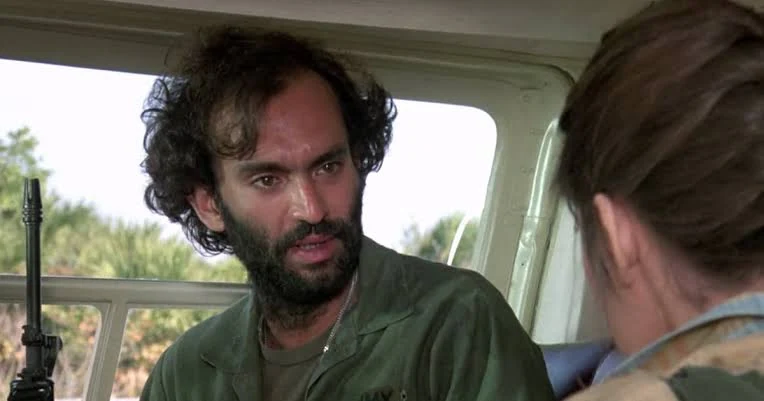
Day of the Dead, 1985. Miguel.
Miguel is a soldier, and Miguel is coming apart. Not stoically. Not with his jaw set. He shakes. He panics. He gets loud, and then he gets useless, and then he gets people hurt — a corral operation goes sideways because his hands won’t do what he tells them, and a man dies for it. The film does not cut away from this. It sits in it, and it makes you sit in it too.
Look at what Romero is actually building there, because it’s three separate things and he keeps them distinct.
Fear is the state. It’s the shaking, the noise, the immediate animal refusal of what’s in front of him. Romero shoots it as sensation — sweat, breath, the body outrunning the mind.
Trauma is the history. Miguel isn’t frightened of one zombie; he is carrying every single day since the world ended, and the film is careful to show us that the load is cumulative, that it has been grinding him down offscreen for months, that the man we meet is already most of the way through a collapse we didn’t get to watch. His breakdown isn’t an event. It’s an accrual.
Strength is the choice — and this is the part that gets missed. Romero doesn’t hand Miguel strength. He hands it to Sarah, who loves him, who has to hold him together, who has to take his arm off with a machete when he’s bitten, and who keeps working the problem the entire time with her face doing every bit of the arithmetic. Sarah is the strongest person in that film precisely because we see exactly what it costs her. She is terrified constantly. She never stops moving.
Fear, trauma, and strength are three different substances, and Day of the Dead refuses to confuse them. Miguel is afraid and traumatized and not strong. Sarah is afraid and traumatized and strong as hell. What separates them isn’t how much either one is feeling. It’s what happens after.
And it’s worth saying what that performance cost the man giving it, because it is the precise inverse of the choice made on that airfield.
Anthony DiLeo Jr. went method for Miguel. He stayed in character across the whole of that shoot — carried the man’s permanent, grinding stress around with him for the duration rather than picking it up and setting it down between setups. Go back to what I said about trauma being an accrual: a load that has been wearing on somebody for months before we ever meet him. You can’t fake an accrual. You can only indicate one. So DiLeo didn’t fake it. He went and accrued it.
And here’s the detail that gets me. By Lori Cardille’s own account, the man himself was a joy to have around. When he passed, what she reached for wasn’t the intensity or the process — it was that he made her laugh every single day they were making that film. Every day. The warmth was who he actually was. The wreck was built, deliberately and nightly, by someone who had decided this character’s pain was going to be earned rather than performed at us.
Set that against the airfield and the argument writes itself. One actor looked at a part made of fear and went all the way down into it, at real cost, for weeks. The other looked at a part made of fear and decided to protect her character from having any. Only one of those choices put a human being on screen.
And Miguel’s fear isn’t decoration, either — it’s the engine. It costs, it escalates, and it eventually detonates the entire third act when he walks out and lets the dead in. A character’s terror moves that movie. Nobody in the history of film criticism has called Miguel a damsel, and nobody has ever suggested Day of the Dead has a weak-male-character problem, because fear read on screen as character rather than as deficiency.
Now — Day of the Dead came later, so it can’t be evidence of what was available to Ross on the day. But here’s the thing: it didn’t teach Romero anything. It only proved, seven years on, how completely he had understood it the entire time. And the proof of that was already sitting in the movie she was standing in.
Roger cracks. He gets cocky, gets sloppy, gets bitten, and dies badly over an agonizing stretch of runtime — in this film. Stephen is jealous and jumpy and incompetent with a rifle, and it kills him — in this film. Harry Cooper spent all of 1968 being a coward in a basement, ten years before anyone rolled a camera at that airfield. Romero’s people come apart constantly, because Romero’s subject is what the end of the world does to ordinary nervous systems. Fear was never the failure state in his films. Fear is the material — and it was already the material, on the page and on the set, the day they shot that scene.
Which means Ross was guarding Fran against something the movie she was standing in had no interest in doing to her. She didn’t need 1985 to tell her that. She needed only to look at what the men in her own cast were being allowed to do.
Not Reacting Is Not Strength
Because here is the thing that apparently nobody said out loud on that set: the opposite of weak is not blank.
Ross took “I don’t want to look weak” and quietly translated it into “I will not react at all,” and those are not the same sentence. They aren’t even the same language. Strength, on screen, is not the absence of feeling — it’s feeling something and doing something about it. Strength is the lunge. Strength is his name torn out of her throat as she dives for the hammer. Strength is grabbing Peter by the collar and hauling him toward the man on the ground. Strength is a face that shows you the full price of the moment and then decides to pay it anyway.
What she gave instead was a woman watching her partner get eaten with all the urgency of somebody waiting on toast.
And the cruel irony — the part I don’t think she saw coming — is that it doesn’t make Fran look strong. It doesn’t even make her look weak, which was the entire thing she was trying to avoid. It makes her look stupid. It makes her look like she doesn’t understand what’s happening, or doesn’t care that it is, or doesn’t love the man it’s happening to. In one long flat stare she strips the character of compassion, of agency, of intelligence — every single thing “strength” was supposed to protect — and hands right back the one quality she was fighting to escape: a woman who is useless in a crisis. She just made her useless and cold.
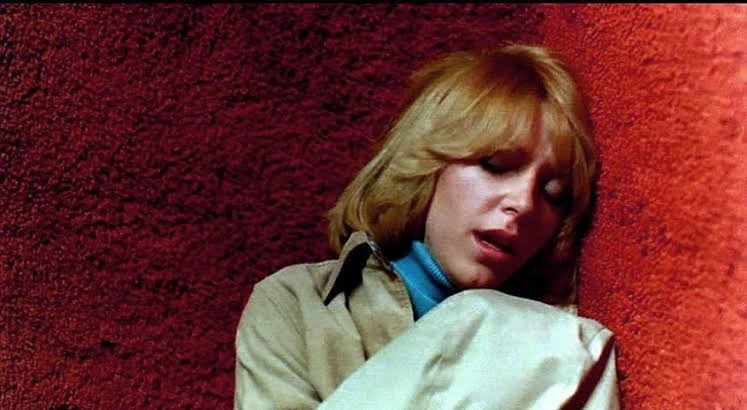
What It Costs Fran
Now let’s talk about it as craft, because this is where a performance note stops being a performance note and becomes a structural wound.
Character is not what a person says about themselves. Character is what a person does when the situation stops asking politely. That’s the whole trade. Every writer, every director, every actor is working the same lever: put a human under pressure and let the audience watch which way they bend, because that bend is the person.
The airfield is Fran’s first real pressure test in this film. It’s the establishing shot of her as a human being in this world. And what it establishes — flatly, without ambiguity, before we know much of anything else about her — is that when the worst thing imaginable is happening two feet away and the solution is lying in the dirt, Fran Parker does not act.
Then comes the mall. And the mall material is genuinely great. Fran is one of the quietly radical women of 1970s horror in those scenes: pregnant, sharp, and flatly refusing to be tucked away and protected. She calls the men out for handing her the coffee-and-worry role while they play soldier. She demands a gun. She demands — out loud, no apology — that they teach her to fly the helicopter, because she is not going to be the one person in that group whose survival hinges entirely on a man staying alive. On the page, that is agency, intelligence, and self-preservation all in one speech. It is exactly the strength Ross wanted to project, written correctly, and the film is rightly praised for it.
Watch those scenes with the airfield still in your head, though, and something sours.
Because the doubt the airfield planted isn’t she’s too fragile to hold a gun. It’s worse and it’s more specific: we have already watched this woman decline to act with the answer in arm’s reach. So when she says teach me to fly, a part of the audience answers back — will you, though? When it counts? When you’re actually in that seat with the dead coming up the stairs, is anything going to happen, or are you going to look around again?
And notice what that doubt is not made of. It isn’t made of her being scared. If she had screamed her head off at the airfield and then demanded a gun in the mall, we’d have believed her instantly — that’s a person deciding never to feel that helpless again, and audiences forgive fear immediately and completely, because every one of us has been afraid. The doubt is made of the opposite thing. She didn’t prove she was scared. She proved she was inert. And “I want a weapon” is a promise about action, delivered by the one character we’ve watched fail to take any.
That’s the damage. Not to her likability. To her credibility — on the exact axis the rest of her arc is asking us to trust her.
What It Costs the Film
A story is a chain of promises. The first act writes checks; the third act cashes them. That’s the machine, and Dawn’s version of it is genuinely elegant on paper: the woman who starts as cargo in someone else’s helicopter ends up the one flying it out.
The destination is already in the movie. Fran does take those controls. That ending exists, and it’s good.
What the airfield does is delete the origin. And you cannot travel from nowhere.
If Fran is already unmoved at minute twenty — unmoved by the worst thing she will ever see, with nothing on her face to tell us it landed — then the woman at the controls in the final minutes isn’t a transformation. She’s the same flat surface, now holding a stick. The climax stops being the payoff of an arc and becomes a plot event: a thing that occurs, rather than a thing that was earned. All the machinery is in place, and there’s no charge running through it.
And it costs the film something sharper still, which I don’t think gets said enough. Dawn of the Dead is about numbness. That’s the entire thesis — the mall anesthetizes the living until they’re shuffling the same loops as the dead, buying fur coats in an empty department store while the world rots outside. Numbness is the disease this movie is diagnosing.
Fran going blank inside the mall would have been the best scene in the film.
Fran going blank at the airfield, twenty minutes in, before the mall has done a single thing to anybody, reads as her factory setting. It isn’t the sickness taking hold. It’s just how she is. Which means the movie loses one of its cleanest available illustrations of its own argument, and gets nothing back for it.
Barbara Is the Proof
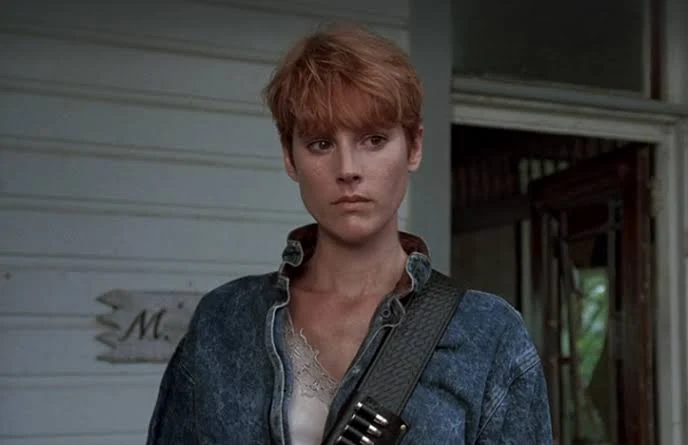
Her story started with screams and ended with survival.
And if you want to see the corrected version — the whole arc, start to finish, done on purpose — the same author went and shot it. Later again. Twelve years after the airfield.
Tom Savini’s 1990 remake of Night of the Living Dead — written by Romero, who used the do-over to rebuild exactly one character from the studs up. In 1968, Barbara goes catatonic in the first ten minutes, stays that way all night, and gets dragged off by her dead brother. She isn’t a character. She’s furniture with a heartbeat.
The 1990 Barbara starts in precisely the same place. Terrified. Clumsy. Sobbing in a cemetery. Losing her brother in front of her and running for a house she doesn’t know with her hands shaking so badly she can barely work a door.
Then the film does the thing. It lets the terror go somewhere.
Every sequence she gets a fraction more functional. Watch her hands across that movie — it’s all in the hands. She stops flinching. She starts looking. She learns the difference between the thing in front of her and the thing that will actually kill her, and by the last act she is the calmest, hardest, most clear-eyed person left in the frame. She walks out of that house. She comes back with the militia. She puts a bullet in Cooper without ceremony. And she gets the line that indicts the entire film — they’re us — because she is the only one who has been paying attention.
That is Ripley-tier, and every inch of it is legible, because we were there for the whole climb.
Three things had to be true for that to work, and all three were: it was written — Romero put the arc on the page in stages. It was performed — Patricia Tallman plays discrete increments, not a switch, so you can point at the scene where each piece of her locks in. And it was intentional — Savini shoots her differently as she changes, gives her more of the frame, lets her stand where she used to cower.
The terror wasn’t the obstacle to Barbara’s strength. The terror was the raw material. There is no badass at the end of that movie without the wreck at the beginning, because strength on screen is only ever measured as a distance traveled.
Which is the exact measurement Fran never gets to have. Twice now — Miguel in ’85, Barbara in ’90 — the same author went back and showed his work, and both times the answer was the same: let them break first, then let them climb. So what happened at that airfield was never the story failing her. It was one choice, laid on top of a story that had it right, by an author who spent the next twelve years proving how right he had it.
The Lesson Nobody Asked Me For
I write horror. I care about this more than is probably healthy, and this scene has quietly become a kind of north star for me — a perfect little monument to a specific, seductive mistake.
And let me be careful, because the lazy version of my point is also wrong. Stoicism can be strength. A character who sets her jaw, swallows the grief, and keeps working the problem while everything burns — that is powerful, and I love it when it’s earned. So this was never “stillness is weakness.”
The trouble is that what Fran does in that scene isn’t stoicism. Stoicism is a held thing — a reaction pressed down on purpose, with a whole person straining behind it. Fran isn’t pressing anything down. She isn’t frozen in terror, which would at least be human. She isn’t in shock. She’s just absent, in a scene she is standing in the middle of.
So the real lesson is sharper than “don’t be stoic.” It’s that stillness has to mean something. Stoic calm means something. Frozen fear means something. Shock means something. But stillness with no reason under it means nothing — and nothing, on a screen, reads as stupidity. If you’re going to hold a character motionless while the world ends around them, you had better know exactly why, because an audience feels the difference between a person choosing not to move and a person who seems to have forgotten she could.
And here is the detail that turns this from a criticism into something closer to a grief, because it means none of it had to happen.
It was written. The scream was on the page. Romero put it there — Fran cries out, Fran comes apart, Fran is a woman watching the man she loves get dragged into the dirt by a corpse. That was the scene as authored. And Ross read it and told him, in as many words, that she wasn’t going to scream and cry, and that if that was how they were doing this then she wasn’t comfortable doing it at all.
So George already knew. He didn’t need until 1985 to work it out and he didn’t need Barbara in 1990 either, because he had written the correct road into this very script, for this very woman, before a single foot of film went through the camera. Scared to capable. Wrecked at a refueling stop and, by the last reel, the one in the pilot’s seat lifting off that roof. He wrote the entire climb. He understood that the ascent only reads if you first show the audience the floor.
I’ll be fair, because the record is: Romero didn’t fight her on it. He rewrote as they went, he agreed Fran needed more spine, and a real share of what makes her great inside the mall — standing her ground, refusing to be handled — came from Ross pushing for exactly that. She was right about the disease. Fran was underwritten. That instinct was a good instinct and the film is genuinely better for her having had it.
She was only wrong about the cure. Because the fix for a woman who does nothing but scream is not a woman who never does. The note should have been surgical — cut the wailing, cut the helplessness, keep the humanity — and instead it was total. Fear came off the table for the whole picture, every scene, permanently. And once you take fear away from a person living through an apocalypse, you haven’t made her strong. You’ve made her unreadable.
She was protecting Fran from looking like a damsel. What she left her looking like was an idiot — and worse, for our purposes here, she left her with nowhere to grow from. The arc George wrote had a floor and a ceiling. She kept the ceiling and threw out the floor, and an arc without a floor isn’t an arc at all. It’s just a woman who was always going to be fine, standing in a movie that never gets to prove it.
And George was right.
And there’s a second rule stacked under the first, which is the one I actually think about when I’m drafting: the first time you put a character under real pressure, that scene is the character. Whatever they do there is what the reader will quietly hold them to for three hundred pages, no matter how many competent, articulate, take-charge lines you hand them later. You can’t argue an audience out of the first thing you showed them. You can only spend that scene well.
Protect your character’s worst moment. Not by making them look good in it — by making them look human in it, and by making sure whatever they do can be built on. Fear can be built on. Grief can be built on. Panic, freezing, screaming, running the wrong direction — all of it can be built on, because all of it is motion in a direction and a person can be moved from there to somewhere else. Blankness can’t. Blankness has no next step. It’s a dead end you can’t develop out of, which is exactly why Fran spends the rest of the film asserting a growth she was never allowed to make.
Real strength is legible either way — whether it acts or deliberately, visibly holds. Give me the woman whose voice cracks on his name and grabs the hammer in the same breath. Hell, give me the woman who stays dead silent and picks it up without a word — that would have been strength too, because silence with a swing at the end of it means something. Just don’t give me a statue and tell me she’s brave. A statue isn’t brave. A statue is just standing there.
So, Yeah.
Dawn of the Dead is one of the best horror films ever made, and I will happily die on that hill. It’s smart, it’s savage, and decades later it is still the definitive word on what these stories are actually capable of being about.
And it is not perfect. It gets stopped, one single door short of perfect, by half a minute of a woman standing still — a good actor, working from a good instinct, taking one wrong turn on the very last word of a sentence she otherwise had exactly right.
And I’ll admit the part that probably costs me a little horror credibility: this one seemingly small thing is why, for all of that, Day of the Dead is the one I love more.
Because Day allows its people to be everything at once. Sarah is allowed to be terrified. Allowed to break down — and then get up, and then break down again. Allowed to stand toe to toe with a tyrant in a bunker and not blink. Allowed to laugh, actually laugh, out loud, at the end of the world. Tender in one scene and furious in the next, exhausted and capable inside the same breath, and a thousand times more human for every bit of it. Miguel gets that same permission. So does damn near everyone down in that hole with them.
That is the thing Dawn gives up. Not its greatness — it keeps that, comfortably, forever. What it surrenders, from one character and one character alone, is the sense that these are human beings living through inhuman times. Everybody else in that mall still bleeds through. Fran is the one place where the film stops feeling like people.
She wanted to make certain nobody could ever call Fran weak.
What she guaranteed instead is that nobody ever got to watch Fran become strong.
She should’ve just let her scream his name — and then let us spend the rest of the movie watching her earn the hammer she didn’t pick up.